
Implementing a Successful Testing Battery
Key considerations when deciding on tests to execute with athletes.

While, in a perfect world, we could perform every possible test with every single athlete and make decisions based on a comprehensive dataset, the real world doesn’t often allow for that. In this piece I’ll dive into some key considerations that should be factored into the test selection process to ensure for a successful testing session with multiple athletes.

Sport
Firstly, the athlete’s sport should sit very high on the priority list to understand the physical demands they will be subjected to. If sport demands aren’t added into the equation early on, I’d argue the tests selected may not be absolutely relevant. When breaking down the demands of the sport and performing a needs analysis, it’s important to understand 3 main elements;
1. The surface that the sport is typically played on, typically grass, turf, ice or court based sports will each have their own unique responses to surface. For example, there will be more traction when performing high speed running or sprinting on artificial turf. While this results in a typically positive outcome of higher maximal velocities, with that comes higher forces for the body to absorb (Sanchez et al, 2020)
2. The muscle groups associated with movement demands. Sports with linear, high speed running dominance may steer towards having hamstring health as a priority while lateral focused sports such as ice hockey may have prioritise the adductors as a key area of focus. This is merely a general, high level example of the differences to look out for, however I would steer towards diving deeper into your specific athletes and their movement demands.
3. Finally, the common injuries associated with the sport typically point you in the right direction for areas that require specific testing. Investigate prevalent soft tissue bases injuries associated with the sport and where applicable, contact based injuries.
Individual
After understanding the sport, I’d recommend diving into a needs analysis of the individual athlete to understand specific requirements of their participation in the sport. 3 main elements that fall into this bucket for me are;
1. Previous injury history is regarded as one of the top predictors of future injury (Jacobbson et al, 2013). With this in mind, a personalised approach should be taken with each individual athlete to understand potential areas of weakness in an objective fashion.
2. Positional demands. While we have general demands of the sport listed above, it’s important to understand the specific demands of this position. Particularly in team field sports, the bandwidth between positions when quantifying high speed running, acceleration & deceleration demand as well as basic volume and intensity across a game can be shockingly wide.
3. Personal goals. It’s absolutely crucial to understand if this athlete is working towards any specific physical goals such as altering body composition, or increasing work capacity towards specific tactical roles within the team. Knowing this allows tests chosen to compliment those personal goals alongside current objectives.
Logistics
Arguably the most important element in my opinion. A perfect world and the real world are both very different things. They key question to ask here is what can you (and your support team where applicable) realistically execute?
1. How many practitioners are available to assist with testing?
2. How much time do you have access to athletes to complete testing?
3. What technology is required to collect data during these tests and do you currently have access to it?
Ice Hockey Example
As an example, I’ve chose the sport of Ice Hockey, which is huge across Canada (where I’m currently based) in both the professional and private settings. For Ice Hockey we know the surface will be an ice rink, the movement demands will be multi directional with key physical and technical requirements involved such as change of direction, multi directional skating and various opportunities for contact. Common soft tissue injuries include adductor strains and hip flexor strain to name a couple while contact based injuries commonly present in the form of concussions and contusions.
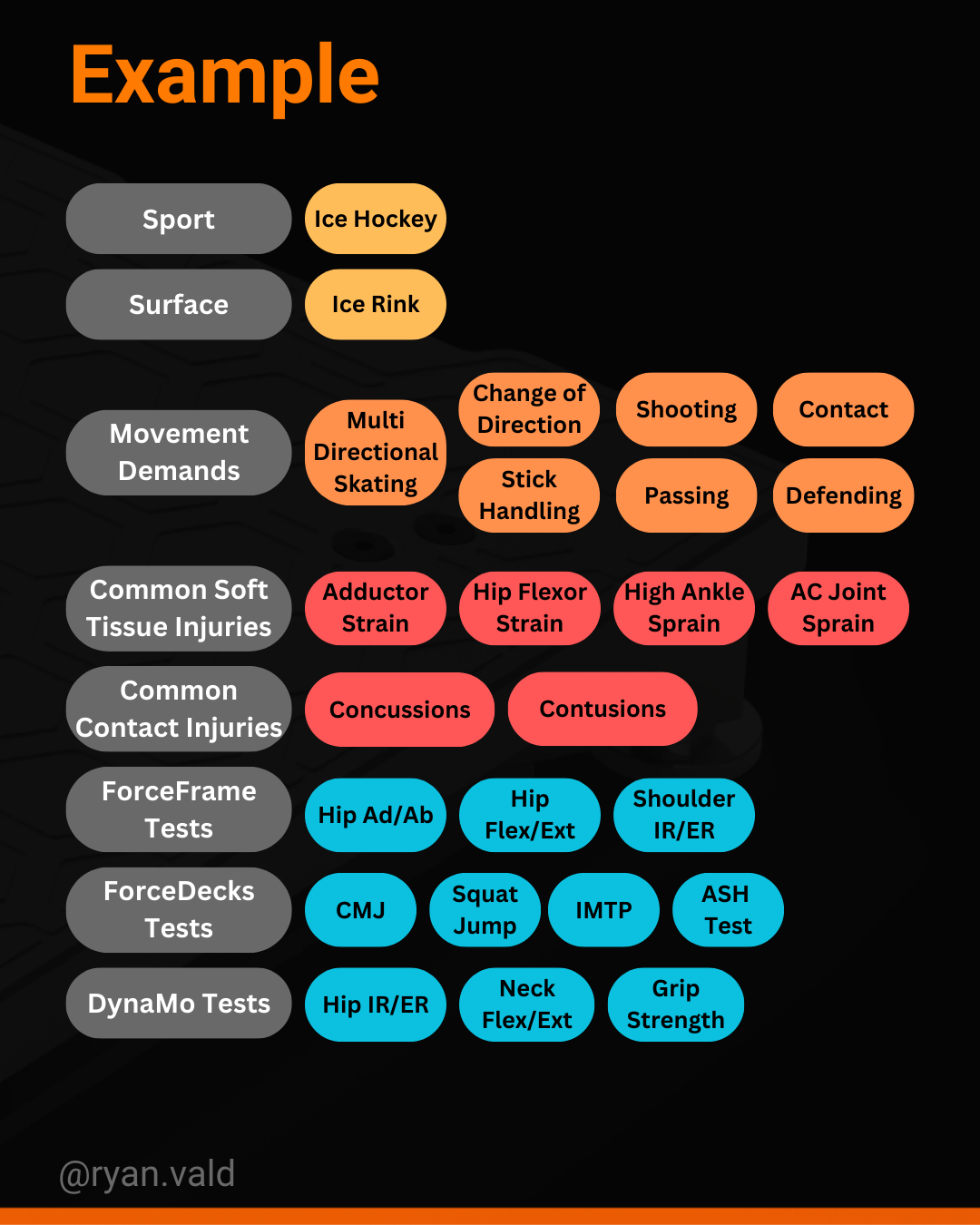
The technology available in this instance includes the VALD ForceFrame, ForceDecks and DynaMo which enables data to be collected on joint specific isometric strength tests, explosive power tests and maximal isometric strength tests.
Now that we’ve completed various segments of a needs analysis on the sport and landed on the tests we aim to execute, the biggest question is still yet to be answered – Logistics. What can we realistically execute? I’ve attached 2 examples below which include varying levels of resource support in the form of practitioners and technology available to assist with data collection in a group of 20 Ice Hockey athletes.
Example 1 “Many Hands (and systems) Make Light Work”
We see the division of work across 6 practitioners, each handling their own station with a unique piece of technology assigned to each station. This allows for multiple tests to be collected at each station and limits the need for athletes to be standing around waiting to be tested and potentially losing interest.
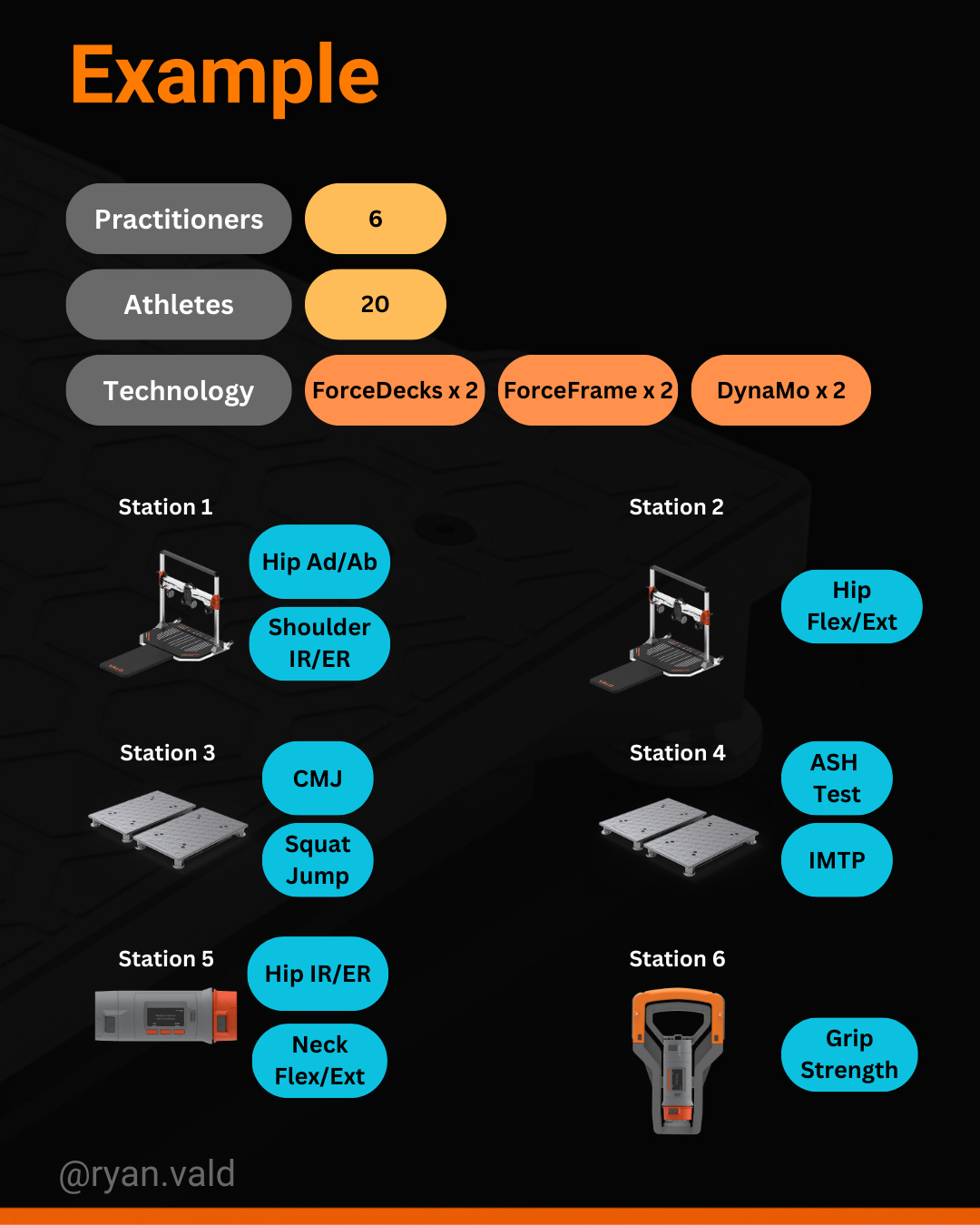
Utilising the ForceFrame, we can quickly switch between testing hip adduction/abduction strength and shoulder internal/external rotational strength by simply rotating the bar to execute the test across both positions. For Hip flexion/extension, we have the freedom to isolate this test pattern to it’s own unique station which helps with set up and execution.

The ForceDecks auto-detect mode make collecting multiple reps of CMJ and Squat Jump a time efficient process, paired with live feedback, the experience for the athletes is always very engaging. On the second ForceDecks station, IMTP testing can be completed with the portable IMTP attachment from VALD, and I’ve found for the ASH test, keeping the plates inside the IMTP tray allows for easy manoeuvrability between the I,Y & T positions of the ASH test.
In our final 2 stations, utilising 2 DynaMo’s allows for quick collection of data. The test batteries feature allow’s for quick data collection of different tests during the same testing process on the app which significantly speeds up the process. Having an additional DynaMo allows for the hand grip strength attachment to remain attached to our second DynaMo at all times and again, helps with time efficiency.
Example 2 “Limited resources edition”
In our second example, we have a 50% reduction in the availability of total resources (practitioners and technology), interestingly though we will still be able to collect the exact same data so this doesn’t become a blocker.
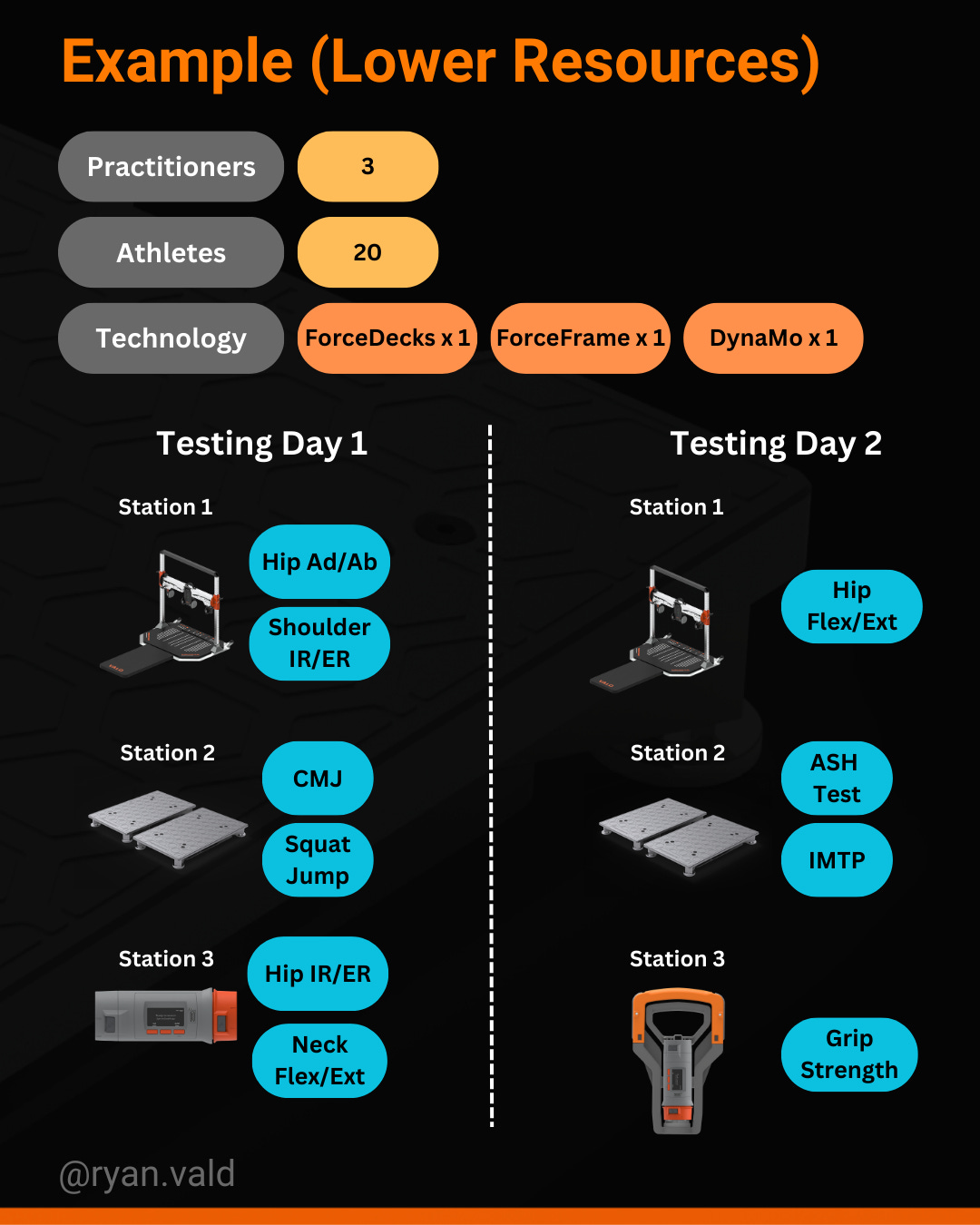
Without going into redundant detail as I already have above, the key difference here is the division of the testing session into 2 smaller sessions. I would recommend these be split across 2 separate testing day’s and as always, it depends on where it would best fit into the group’s weekly schedule.
When splitting testing across 2 individual days, it’s really important to ensure athletes are in the best position to give their maximal effort on both day’s. External factors like training load response or competitive demands may provide friction with this set up so it’s crucial to plan in advance and ensure to limit the influence of these factors as much as you can.
I’m keen to connect and hear about any other novel set ups for testing you’d implemented within your respective teams/groups.